| Dmitry A. Zaitsev |
Command line tool. Input text file describes a source Petri net. Output files contain descriptions of subnets. Large scale nets may be processed. Source net is devided into the set of its minimal functional subnets. Platforms: Unix, Windows, MS-DOS.
Deborah uses .net and .ndr formats of files accepted in system Tina.
Adriana - program for calculation of Petri net linear invariants in the process of composition of functional subnets.
Command line tool. Input text file describes a source Petri net. Output file containes basis invariants. Large scale nets may be processed. Invariants are calculated by Toudic's method with application of simultaneous or sequential composition of minimal functional subnets.. Platforms: Unix, Windows, MS-DOS.
Adriana uses .net and .ndr formats of files accepted in system Tina.
Scaler - the program for increasing in any number of times of the image transmitting in a graphic mode to the matrix printer
Gelio - the program for calculation of the increased risk days
Opera-Topaz
Documentation
:
the user's Guide.
Download
Some
history: Opera represents a whole epoch of my life. I had to retreat from the world around me, searching for quiet places to write, write, and write… ultimately producing about 100,000 lines of C source code. When friends asked, “What are you working on?” I would reply, “I am writing an opera.” Before that, I spent several months in the production-dispatching department of the Topaz Plant, literally absorbing the realities of the management process in product manufacturing. I also debugged the system there—our department didn’t have a personal computer for me at the time. The system rests on two cornerstones: theory – the most advanced concepts, including Petri nets from A.I. Sleptsov, management principles from Yasuhiro Monden’s CANBAN, heuristics from V.V. Shkurba, and other sources see here; practice – guided by V.S. Bolgarov, who has since moved from departmental leadership to the upper echelons of power. Later, the Motorostroitel Corporation adopted Opera, but during those challenging postgraduate years, a contract with Topaz—secured through the insistence of the head of the management information systems department—was what allowed me to stay on solid ground. Opera was born in 1990.
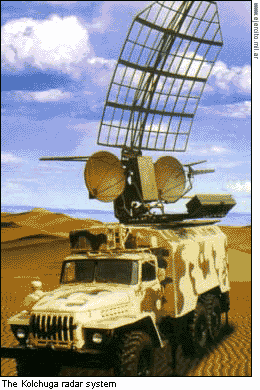
Note: Topaz - the plant where "Kolchuga" is produced. Motorostroitel - the largest airplane motor building corporationa in Ukraine.
Nevod
Documentation
:
the Description of application, the user's Guide.
Download
Some
history:
Although Opera was grandiose, it was too specialized, while Petri was universal but more of a toy. For a long time, I wanted to create a universal modeling system with a wide range of service functions—but there was no one to fund it. Cooperation with the Pentagon was still out of reach. Then A.I. Sleptsov discovered the Minsk Woodprocessing Combine through the enthusiast Golenkevich, who wanted to use Petri nets to solve a real problem: power protection management for the enterprise. Once again, practical needs drove the development of the necessary set of service functions. Golenkevich came to us, drew his huge networks, and started the modeling process. We added the required code and fixed bugs along the way. Nevod was delivered in 1992, and everyone was pleased.
Sergo
Documentation
:
the Brief user's guide.
Download
Some
history: On May 1, 1991, I was at my mother-in-law’s place when I went to a local machine-building factory to offer Opera. There, almost spontaneously, a real job was born—paid work for real Sergov enterprises of power stations. The results were expected by the end of the holidays. The source code from my libraries was sent by bus. I worked on the project at night and programmed in the afternoons in the empty factory department. Somehow, I made it on time. By the end of May, the circuits of the electric substations were completed. I added service functions and fixed the bugs.
Petri
Download
Some
history: Anatoly Ilich Sleptsov, my supervisor for scientific studies, once told me that Petri nets were so powerful that even the Pentagon had begun using them for planning military operations. With the advent of personal computers, a magnificent opportunity arose: nets could now be drawn directly on the screen instead of being entered as long, cumbersome matrices. It was 1987, and the first class of Yamaha personal computers appeared at the teachers’ retraining center. Occasionally, I could spend a few hours there developing a basic modeling system. Soon, the program allowed not only the drawing of nets but also the simulation of their dynamics. At that time, we would photograph the networks directly from the computer screen for use in articles—a rather funny solution in retrospect. With the arrival of ÅÑ1840 and Nejrons, the programs were rewritten for IBM-compatible architectures. This work was financed by Korolyova Corporation, which used the system to model computing structures for tasks like distributing printed-circuit boards and crystals.
Scaler
Download
Some
history: Yes, the path to defending my dissertation was fascinating—like gliding down a smooth glide path. In May, I had presented at a seminar with V.I. Skurikhin. The text was written over the summer, revised and corrected until November; by then, I had passed the specialty examination in the council, and the defense took place in December. I quickly prepared the author’s abstract and issued it. Then came the posters. I even bought feathers for ink and felt-tip pens to draw the first lines. Laziness! After all, all of this had already been illustrated in figures in the texts prepared with ChiWriter—they just needed to be enlarged. And the printer’s width? It only printed in strips, which had to be carefully stuck together. Immediately, I ran to my childhood friend Sergey Khrapko in his department—my own computer wasn’t handy. We pulled out the printer documentation with graphics codes, studied it, chatted a bit, and by the evening had written a working program. Later, Sergey ran it independently while I continued on my glide path. At the defense, no one else had posters printed directly from a program—they were all handmade. Notice: the program was virgin, like a new nucleus in RSX-11M; its innocence was only lost when it ran on the first computer.
Gelio
Download
Some
history: The early, tiny hand-made program, without any service functions, wasn’t paid for. But somewhere along the way, I saw the Chinese horoscope and thought: maybe it could be useful to someone. Artur Rizhkov, an enthusiast of Eastern martial arts and all things magical, had somehow dug out an ancient volume calculating days of increased risk. He longed to explore the shamanic field and its insights. I had written this little program in a hurry, and he began carrying long lists of workers from motor-vehicle garages and depots, trying to prove to their managers that failures occurred on days of heightened risk. And then he disappeared. An interesting story…
Note: the program documentation is submitted in MS-DOS coding
and may be seen, for example, with the help of an environment Far
.
Code conversion makes unreadable pseudographics symbols.
| Dmitry A. Zaitsev |